The Case of the Missing Bullet

How do electrical connections in classic cars mysteriously get disconnected?

When those connections are made using bullet connectors, it’s actually pretty easy. All at once on the MG, the windshield wipers and heater blower didn’t work.  There is an inline fuse for the wipers, but that was in good shape.  It turns out the wipers and blower motor and were on the same circuit, sharing green/pink wires joined with bullet connectors behind the radio.

Bullet connector contacts fit one inside the other. While it usually takes a pretty good yank to do so, it’s possible to pull the connectors apart.  That must have happened the last time I checked the gearbox oil. There’s a dipstick located right in the middle of things back there, and it’s easiest to pull and relocate it by feel. I must have caught the wires up in the process.

Thanks to Rick Astley’s excellent book MGB Electrical Systems and a quick Google search, I was able to confirm the wire colors and their location. I easily located and mated up the wires, restoring the circuit.  While I was neck deep behind the radio, I managed to solder an extension wire to the cigarette lighter, restoring that to rude health.  I spliced the extension wire into the middle of the original wire, so that the original color could be easily seen at each end, keeping color codes traceable. If I can keep myself from rummaging around behind the dash, things should be good, for a while, at least.  Based on the photo, a little vacuuming is in order. That’s next.

IMG_0525

Not as Bad as it Looks…

Oil Dipstick 4

Gearbox Dipstick (Upper Right)

IMG_0524

All Back Together (For Now)

Complexity: Low. Aggravation Factor:  Low. Compensation:  1 Beer.

Stranded (and Desperate) on The Res

mgbreakdown

The darkness threatened to swallow us whole.

By this point, I had a flashlight out the window, hunting for the white line on the edge of the road. Our headlights were now so dim, the oncoming traffic barely knew we were there.  As we felt our way through the fading twilight, we crested a gentle hill. The car stumbled and gave up.

Bob and I are both veteran classic car owners, so we knew we weren’t getting out of this one easily. We’d taken what turned out to be a poorly calculated risk, knowing that our generator’s control box, a sealed unit full of windings and other old school contrivances from Edison’s era, was trying hard to let us down.

We’d put up with it all week at a classic MG event in Phoenix, with some minor fuss, including replacing the generator, which was easier to find locally than a healthy control box. Despite the late hour, we thought we could make it to Cortez, Colorado, our scheduled overnight stop. The current draw from the headlights did us in.

For us, it wasn’t the What went wrong as much as the Where. We were in Arizona, northbound on U.S. 191, a two lane ribbon of asphalt cut through an epic Western movie backlot, in the heart of the Navajo Nation, known locally as The Res. Covering more than 27,000 square miles across parts of New Mexico, Utah and Arizona, the Res is vast, sparsely populated, and not without its problems. Its residents struggle with limited economic opportunity, their share of alcohol and drug abuse, and the highest crime rate of all Native American reservations in the U.S.

There was virtually no shoulder. After managing to push our stricken 1967 MGB to a narrow perch just off the road, we started phoning. I worked the AAA while Bob dialed 911. Bob’s experience set the tone for this misadventure. “Can you help? we’re broken down on Highway 191.” “I’ll transfer you,” the dispatcher said. A few clicks and a buzz later, nothing. Dead air. We called back. “This is Utah 911. Hold on, I’ll transfer you.” Another failed transfer. After the third failed attempt, Bob quit dialing. In the meantime, I was having my own struggles with the AAA. My membership had expired the previous month, so I was transferred to my local club for reinstatement. After wrestling with several dropped calls, my phone rang. “AAA called and said you were in danger, are you all right?” my anxious wife asked. Since our dark green car had virtually disappeared in the gloom, I’d told the AAA dispatcher that we were not in a safe place, thinking that might add some urgency to our situation. Before the call dropped, the AAA dispatcher advised us to call 911. Then, somewhat mysteriously, they called my home. I took advantage of the good connection and asked my wife to work things from there. We needed a wrecker. How hard could that possibly be?

Continue reading

Welcome to NSNF!

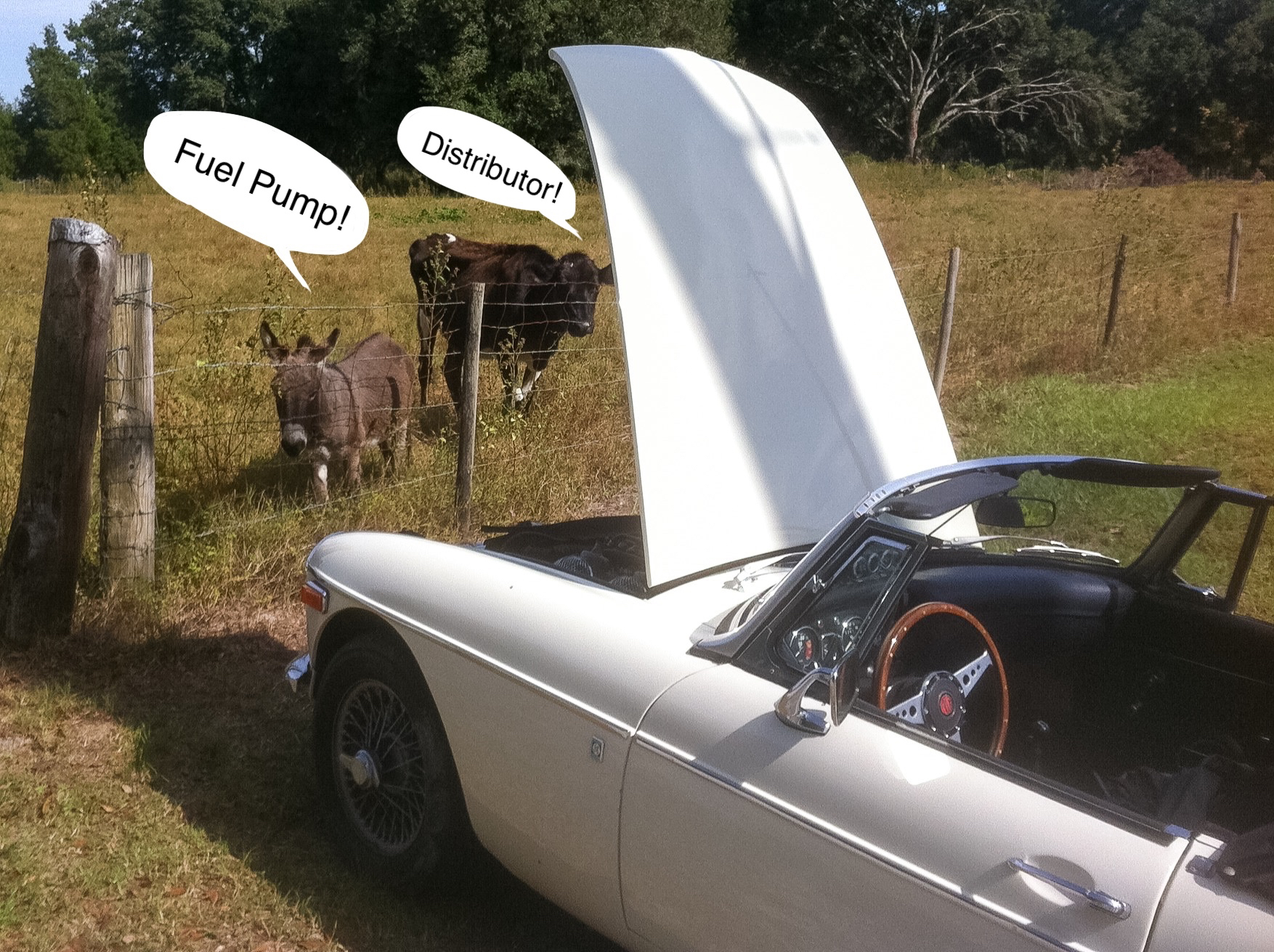
donkey

Ride along as I stumble my way through classic car maintenance and repair.  

When a car won’t run, it usually comes down to either ignition (spark) or a problem with fuel delivery.  It gets interesting when you have trouble telling which is which. I’m a barely competent mechanic, and that’s where the fun begins. These are “tell all” stories. I won’t hold anything back – you’ll witness the frustration, the folly, the fruitlessness of half-baked repairs and unsuccessful quick fixes as I struggle to keep two classics on the road.

I have two cars I’ll be wrenching on (and cursing at) : a 1999 BMW 323i, owned since new, with 140K miles, and just beginning to misbehave with wonky electrics, cranky idiosyncrasies, and intermittent mechanical problems, and a 1971 MGB – surprisingly robust, with ancient but dog simple mechanicals, aging electricals and just enough quirks to drive you to drink.

Aggravation Ratings

And speaking of drinking, I’ll be rating each project as to the number of beers required for adequate post-project compensation.  Remember, don’t drink and wrench.  The limb you save will most likely be your own.

There’s Upside Too

We’ll also talk about things that work well, as well as the joys of banging around in a pair of aging museum pieces.  So buckle up.  I’m pretty sure we’re in for a bumpy ride.

-Greg Peek